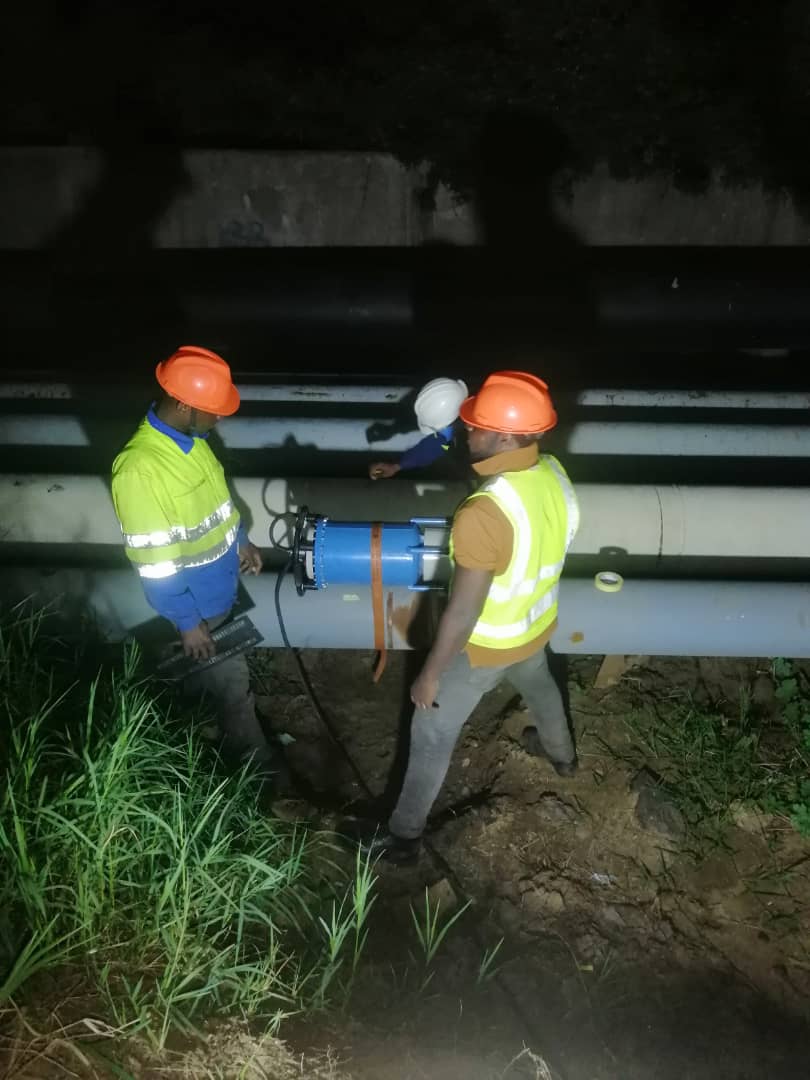

Ultrasonic Testing (UT) is one of the more common non-destructive testing methods performed on materials. This testing utilizes high frequency mechanical energy, i.e. high frequency sound waves, to conduct examinations and measurements on a test area.
Typically the UT inspection system consists of a ultrasonic transducer, pulsar/receiver, and display unit. A pulsar/receiver is an electronic device that can produce high voltage electrical pulses to the transducer. When driven by the pulsar, the transducer generates high frequency ultrasonic sound energy into the material in the form of sound waves.
When there are discontinuities such as inclusions, porosity, cracks, etc. in the sound path, part of the mechanical energy will be reflected from the discontinuities’ (reflectors’) surface.

The reflected sound waves signal received by the transducer is then transformed back into an electrical signal and its intensity is shown on the display unit.
The sound waves travel time can be directly related to the distance that the signal has traveled. From the signal, information about reflector location, size, orientation and other features can be determined.
Key Benefits
Some of the various advantages of this UT method is;
- Capable of portable or highly automated operation
- Can be performed on all types of materials
- High accuracy and reproducibility in flaws detection
- Generally only one surface needs to be accessible
- Fluid level check in enclosure
- Materials characterisation

Industries Of Applications
Ultrasonic Testing is widely used for;
- Checking the quality of welds in pipes for the offshore oil industry
- Flaw detection and evaluation of materials
- Aerospace industries
- Military defence
- Offshore and marine industries